
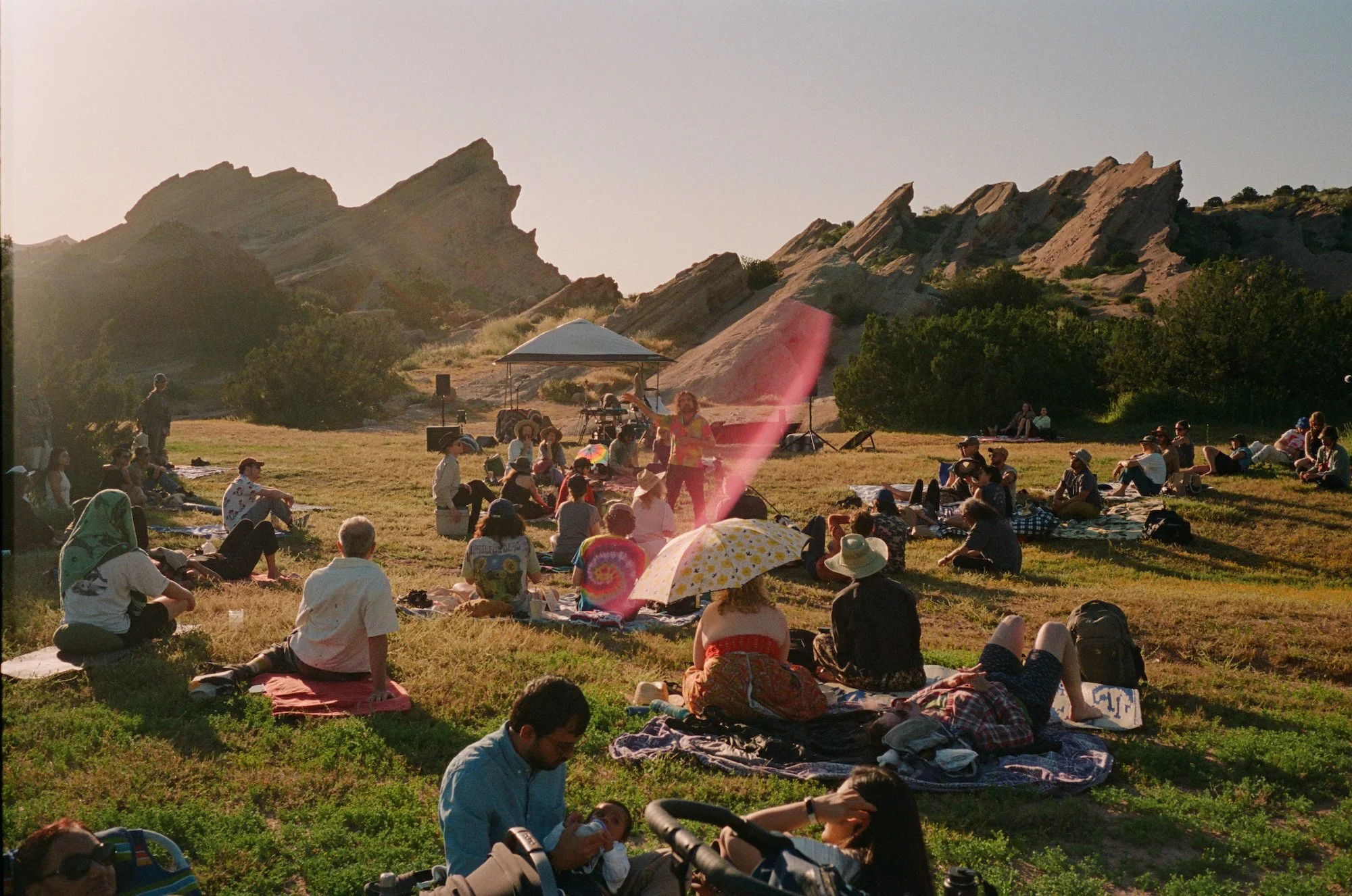

We believe - and research is beginning to show - that urban nature exploration is linked to conservation. When we understand what’s out there, we better appreciate it. When we appreciate it, we protect it. It’s here for everyone - it’s right outside, right now.
— Dr. Lori Bettison-Varga, President and Director of the Natural History Museum of Los Angeles
Hello from Spring of 2026, a world in which each day is not only a struggle for species survival and that of our natural environments, but for the simple existence of downstream generations. In this present continuum, saturated by neoliberal determinations of empire and progress, of greenwashing and hollow promises to reduce carbon emissions, we write this to ask: how do we as an interdependent peoples continue to educate one another on ecological crises, to provoke constructive paradigmatic shifts, and practice new models of hopeful resiliency?
For Living Earth, music is a prism through which we understand our planet. Music can hold records of past civilizations or indicate the welfare of disparate societies, while the phenomenon of sound itself offers a tool through which to recognize our sonic environment and find attunement within the world. What we find so wondrous about music as a form of direct action, is that it centers the act of deep listening, of decentering the individual in service of channeling the collective. In an anthology of her work, Sounding the Margins, Pauline Oliveros writes:
“Deep Listening is listening in every possible way to everything possible to hear no matter what you are doing. Such intense listening includes the sounds of daily life, of nature, or one’s own thoughts as well as musical sounds. Deep Listening Represents a heightened state of awareness and connects to all that there is.”
Her devoted studies of Deep Listening informed her own compositions, from the notion that music can play a role in expanding consciousness, and that when applied, old patterns can be replaced with new ones. Change is often inscribed in sound faster than it transforms society. For the past 50+ years, much of professor Bernie Krause’s work in the field of soundscape ecology has been to record and archive natural soundscapes. Through his geospecific soundmarks we’ve been able to sonify the impact that industrial development, air travel, and logging industries have had on wildlife populations, and over the last decade our own National Parks Service has adopted this practice in the development of their Natural Sounds Division. Listening is a mechanism for survival, and as we approach climate catastrophe, simple awareness carries seeds of responsibility.
To divest reliance from fossil fuels and the perpetuance of toxic dominant models (ie. 21+ clubs, music fueling the industry of alcohol & real estate speculation, emphasis on nightlife, etc), we’ve invested in a relatively affordable, mobile, solar powered production kit that we pack into a push cart. In process, practice, and praxis we hope to document and share a scalable model for pairing soundscape with landscape, to inspire others to experience, better understand, and care responsibly for each of our bioregions.
As musicians, if our reconnection to what’s been othered as “nature” can be radically altered by engaging in sharing art outdoors, then can the act of deep listening become a vehicle to encourage the same in others?
We’re often on the move, and this intro was basically written on a napkin between our gatherings. This page and our environments tab will continue to be updated and we hope to see you out here…
We see emerginig, piecemeal and with the greatest ambiguity, the seeds of a new noise, one exterior to the institutions and customary sites of political conflict. A noise of festival and freedom… it may be the essential element in a strategy for the emergence of a truly new society.
— Jacques Attali, Noise: The Political Economy of Music